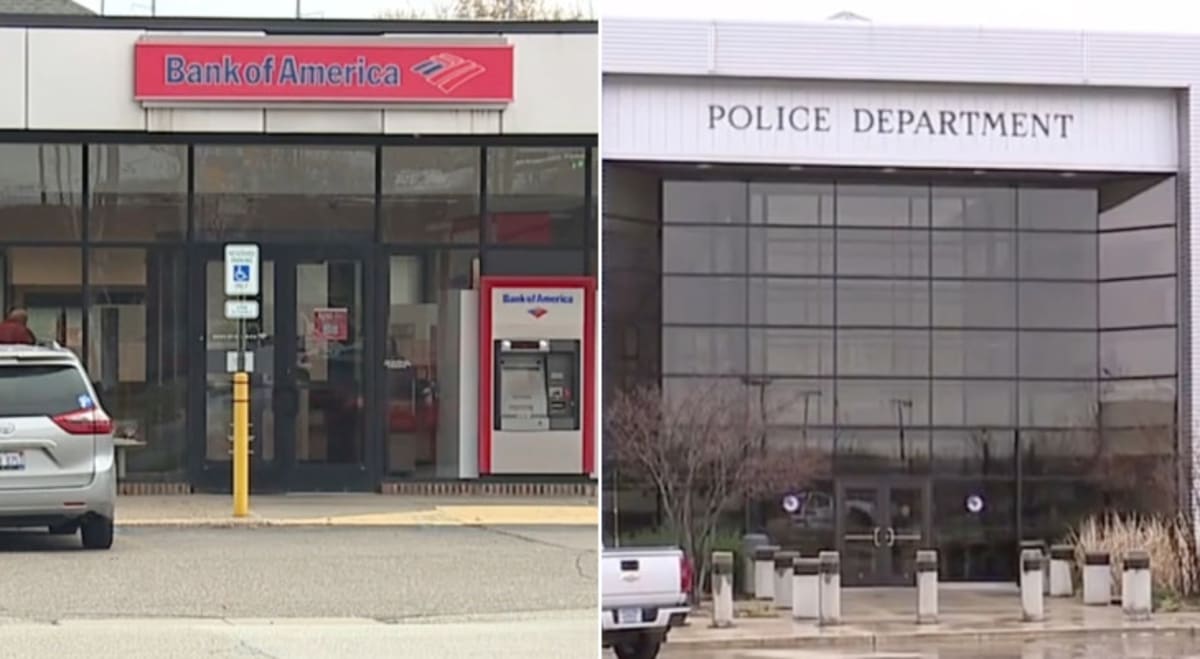
'What are you doing, dude?': Detroit cop caught on camera taking a wallet at the bank, denies trying to spend $5K at his own business

A Detroit police officer resigned after security footage at a bank allegedly showed him taking a wallet that didn’t belong to him in September.
As reported by WXYZ-TV, Officer Arron Swartz Jr. was off duty and visiting a bank as a customer. Following the incident, a Troy detective called him and confronted him about the alleged theft.
Must Read
Dave Ramsey warns nearly 50% of Americans are making 1 big Social Security mistake. Here’s what it is and 3 simple steps to fix it ASAP
A single line on your car insurance policy could be inflating your premium by up to 30% — here's what to change
Jeff Bezos backs a platform that lets anyone invest in rental homes for as little as $100 — 5 ways to build wealth like a landlord without actually being one
When Swartz told the detective that he was a police officer, the detective replied, “Come on, man. What are you doing, dude?”
Eventually, Swartz admitted to having the wallet. Police counted the money inside and found that it was $300 short of what the owner claimed was inside.
The detective who spoke to Swartz asked him about two attempted $5,000 credit card transactions with Nu Look Auto Sales, a Michigan company registered under Swartz’ name.
Swartz was suspended without pay and ultimately resigned. In a statement to WXYZ-TV, he said he picked up the wallet accidentally, denied using the credit card inside it and added that no charges had been pressed against him.
How crimes by police officers are investigated
When a police officer is suspected of a crime, whether it’s an off-duty officer or someone committing a crime in their official capacity, how that crime is investigated and what action is taken is essential to building trust.
Across the U.S., forces have an Internal Affairs (IA) department that investigates police misconduct.
In 2022, the National Internal Affairs Investigations Association published a survey report. It said that very little IA research had been done previously. The survey, which was sent to 436 large police departments, received 213 responses.
It found that while the vast majority of responding departments had a general policy toward citizen complaints, only 52.4% of them regularly reviewed complaints and only 20.7% had made any changes to their complaint system in the year prior. Only 3.5% performed integrity tests, where an officer posing as a civilian submits a complaint to see how effectively it performs.
Not all departments responded to all questions. Of the 213 that responded to the survey, 192 responded to whether they had a complaint policy at all, and only 143 responded to whether complaints were regularly reviewed. On average, 32% of citizen complaints were sustained, but disciplinary action was only recommended 15.8% of the time.
Read More: Millionaires under 45 hold only 32% of their wealth in stocks. Here’s where their money is actually going
How civil asset forfeiture allows police to seize property
As discouraging as IA statistics might be, they are far from the only issue that has been raised regarding police interactions with the public.
Civil asset forfeiture laws allow police departments to seize assets like money, vehicles and property if they are believed to be connected to a crime. The Leadership Conference on Civil and Human Rights calls it “legalized theft.”
A 2019 Supreme Court decision ruled that the Excessive Fines Clause of the Eighth Amendment applies to states, which is intended to limit the severity of civil asset forfeiture.
However, experts agree that civil asset forfeiture is an ongoing, unsolved problem. In March 2026, the Institute for Justice published the newest edition of its Policing for Profit report.
It might seem extraordinary that a police officer could be suspected of stealing someone’s wallet and attempting to spend the money inside without being charged with a crime.
However, in 2023, 45 states collected $300 million through civil asset forfeiture, along with $4.5 billion collected by federal officials.
What To Read Next
Robert Kiyosaki issued grim warning for baby boomers. Many could be ‘wiped out’ and homeless ‘all over’ the country. How to protect yourself now
The tax breaks in Trump's 'big beautiful bill' expire after 2028. Here are 4 moves to make before the window closes
Here’s the average income of Americans by age in 2026. Are you keeping up or falling behind?
US Federal Reserve delivers warning to 100% of Americans with a savings account: ‘There will be a reckoning.’ Is your cash in serious danger?
This article provides information only and should not be construed as advice. It is provided without warranty of any kind.
Source: Crime



0 Comments