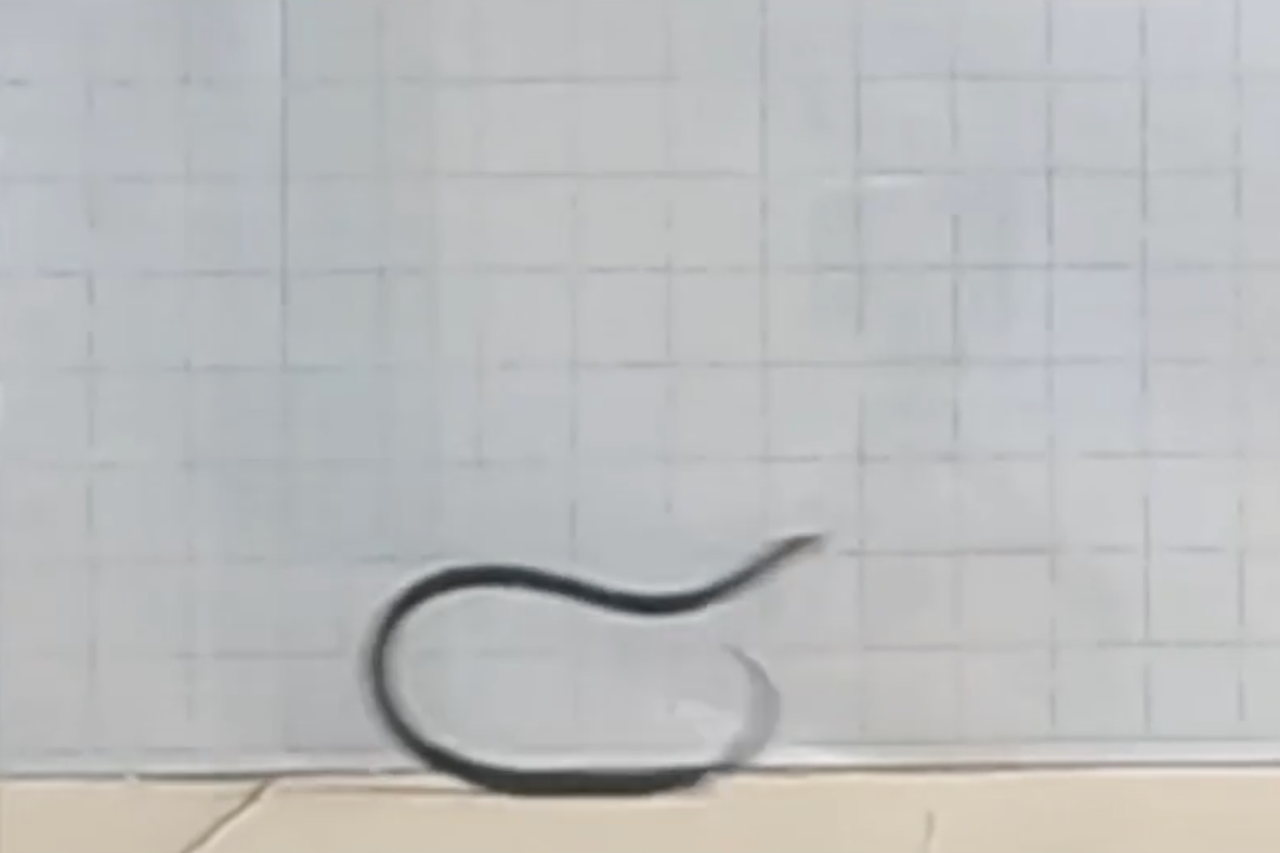
The snake that cartwheels at high speed to escape predators

The dwarf reed snake curls its body into a loop and cartwheels at high speed to escape predators, a discovery that sheds more light on unusual animal locomotion.
Rolling motion is rare in animals mainly because it requires precisely coordinated movements, crucially with the head and most of the sensory organs remaining stable.
This is more challenging to achieve at speed, making rapid and controlled rolling inherently difficult.
Researchers first documented the unusual cartwheeling motion of the reed snake in a study in 2023, but couldn’t explain exactly how it achieved this feat.
Now, using high-speed cameras, they discovered that the snake was able to keep its head stable while rapidly rotating much of its body rapidly.
This shows how animals may sometimes perform innovative movements that are difficult to predict from their body shape alone, researchers say.
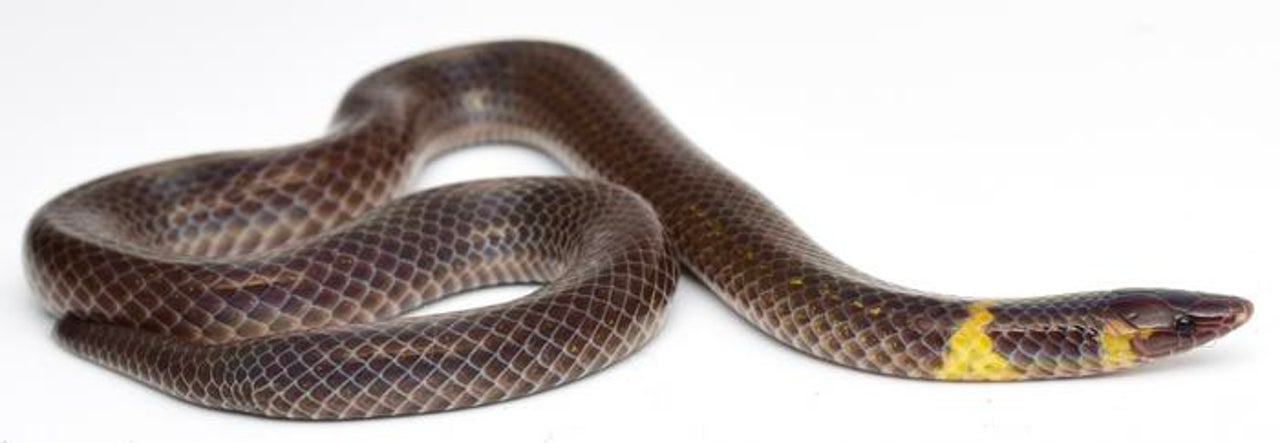
Dwarf reed snake (Yosuke Kojima)
In the latest study, researchers recorded dwarf reed snakes, which are native to Southeast Asia, from multiple angles and analysed their movements in detail.
They found the snakes could reach peak speeds of 1.7-3.7m/second during rolling, about the pace of brisk jogging in humans or four times the typical peak speed in crawling snakes.
The snake doesn’t rotate its entire body as a single unit, but performs a number of movements as part of a cycle.
In each cycle, or “stroke” as researchers call it, the snake rolls with one side of its body in contact with the ground and then swings an arched section of the body down, past the side of its head, towards the ground. In the next cycle, it changes the side of the body touching the ground. Between the cycles, the snake’s tail pushes it for a fraction of a second into the air, before it lands on the ground to initiate the next rolling stroke.
“These observations indicate that dwarf reed snakes achieve continuous locomotion through the combination of rolling motion and bilaterally symmetrical alternating body movements,” the new research, published in the journal Current Biology, noted.
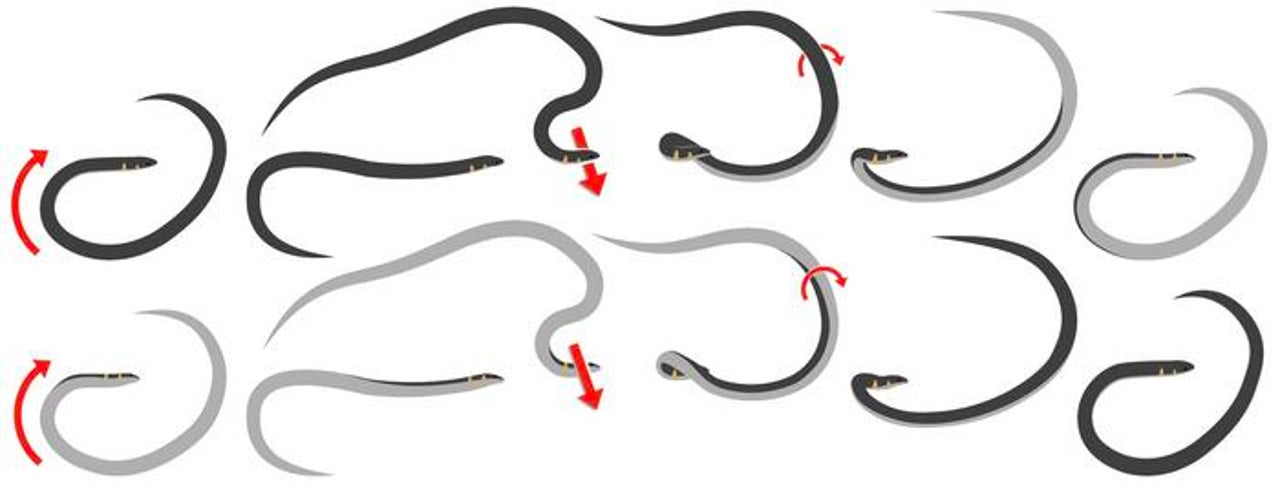
Cartoon illustrating how dwarf reed snake’s roll (Yosuke Kojima, Kanon Tanaka)
Crucially, even as its body undergoes rapid rotational motion, the snake stabilises its head and keeps it aligned with the direction of travel.
This is comparable to head stabilisation seen in flying snakes, which maintain constant head orientation during take-off despite other large body movements, researchers say. The reed snake’s vertical position also remains relatively stable, particularly as it rolls faster.
It is this combination of rapid body rotation and a stable head that seems to help the snake maintain control during high-speed rolling.
The study highlights, researchers say, how animals may adopt innovative behaviour to overcome their physical limitations.
Source: Nature



0 Comments